
Refurbished mobile phones, quantified
Lever Room helped One NZ turn its refurbished phone pilot into a credible, evidence-backed customer proposition - quantifying the carbon benefit of choosing refurbished over new and giving the business a robust basis for communications, commercial decisions and circular economy strategy.
Opportunity
One NZ was preparing to bring refurbished mobile phones into its customer offering as a more affordable and lower-impact alternative to buying new.
The commercial opportunity was clear. Refurbished devices could give customers access to quality phones at a lower price point, while helping One NZ extend the life of existing devices, reduce eWaste and build a stronger circular economy proposition.
But the sustainability claim needed to hold up.
For many products, particularly electronics, a significant share of lifecycle emissions is created before the customer ever starts using the product - through materials, manufacturing and supply chain activity. That makes device life extension a potentially powerful climate lever, but only when the benefit is measured carefully and communicated responsibly.
One NZ needed more than a broad better for the planet message. It needed credible, product-level evidence that could answer a simple but commercially important question:
What carbon benefit is created when a customer chooses a refurbished mobile phone instead of an equivalent new one?
The answer needed to be technically defensible, commercially useful and clear enough to support customer-facing communication.
Approach
Lever Room developed a product-level avoided-emissions assessment for One NZ’s refurbished phone pilot.
The work compared the lifecycle emissions associated with refurbished devices sold through the pilot against an equivalent new-device scenario. This created a practical basis for estimating the carbon benefit of choosing refurbished over new.
The assessment considered the major lifecycle stages relevant to mobile phones, including manufacturing, transport, use and end-of-life. It also accounted for the refurbishment activity required to prepare devices for resale.
Our role was to make the evidence both robust and usable.
That meant establishing a credible comparison, applying lifecycle carbon data, reviewing variation across device models, and translating the results into claims that could be used with confidence. The work was designed not only to produce a number, but to help One NZ understand what the number meant, how it could be used, and where the boundaries of the claim needed to sit.
This matters because avoided-emissions claims are only as strong as the comparison behind them. They rely on a clear counterfactual: what would reasonably have happened otherwise? The quality of the result depends on the relevance of the comparison, the strength of the assumptions and the transparency of the communication.
The Lever Room gave One NZ a practical evidence base that could support the launch of the refurbished phone offer, while also informing future thinking around circularity, product carbon impact and Scope 3 emissions.
Outcome
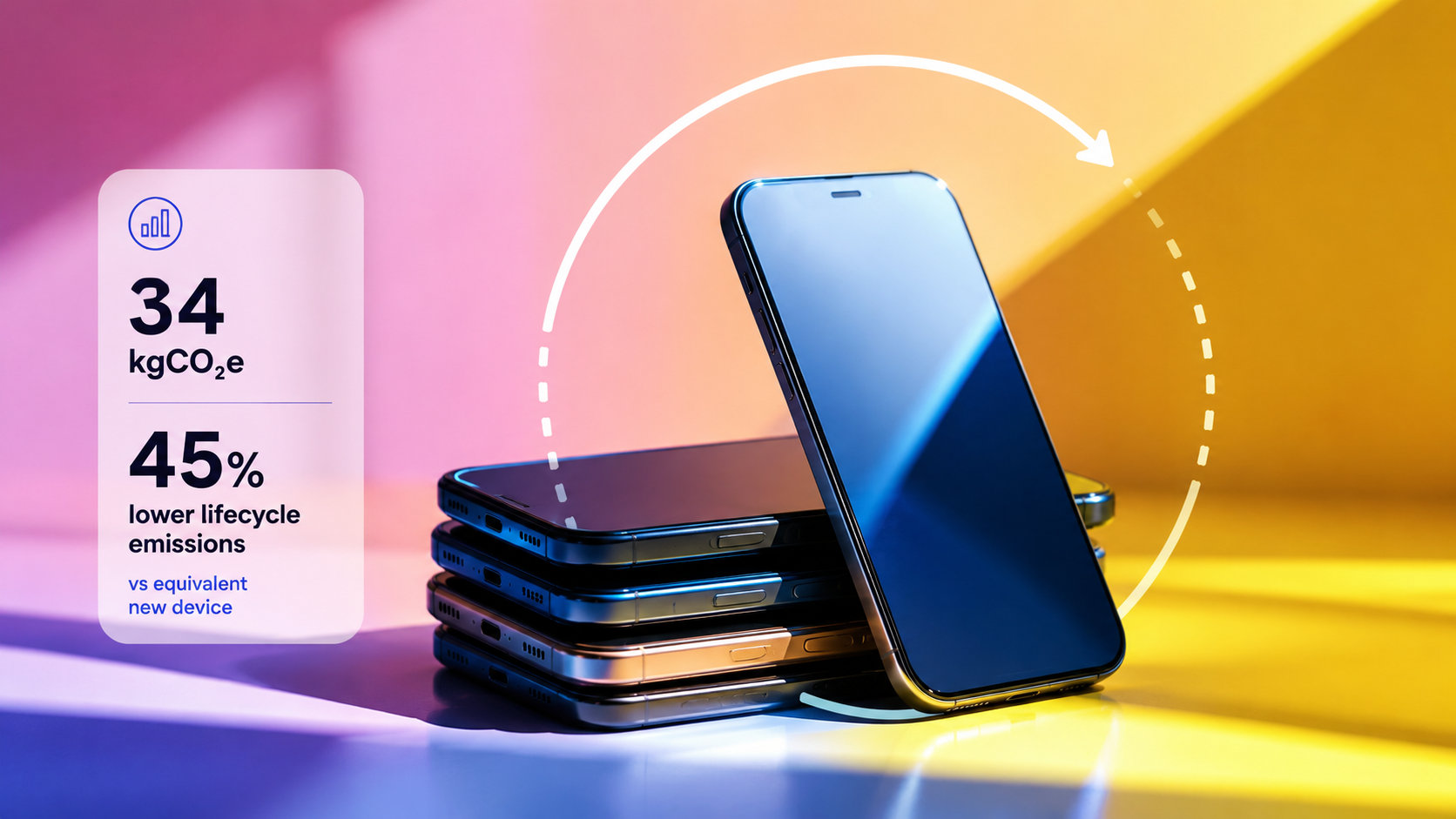
The modelling found that refurbished phones sold through One NZ’s pilot were estimated to avoid an average of 34 kgCO₂e per device compared with buying an equivalent new device.
This represented an estimated 45% reduction in lifecycle emissions on average, with results ranging from 43% to 49% across the device models assessed.
For One NZ, the value was not just the carbon result. It was the ability to use that result commercially.
The work gave internal teams confidence that the claim was grounded in evidence. It helped make the climate benefit of refurbished phones easier for customers to understand. And it connected a customer-facing product initiative to broader business priorities, including circular economy, eWaste reduction and Scope 3 emissions management.
In practical terms, the assessment helped One NZ move from a strong sustainability idea to a credible, evidence-backed proposition: refurbished mobile phones that are more affordable for customers and materially lower in lifecycle emissions than buying new.
For Lever Room, the project shows how carbon modelling can create business value when it is built for decision-making - not just reporting. By turning product-level climate analysis into clear commercial evidence, we helped One NZ plan, act and communicate with confidence.
Featured in The Spinoff
One NZ’s refurbished phone launch has also been featured in The Spinoff, including Lever Room’s role in the product carbon modelling behind the pilot.
Read The Spinoff article here: [Your next phone doesn’t need to be a new one]