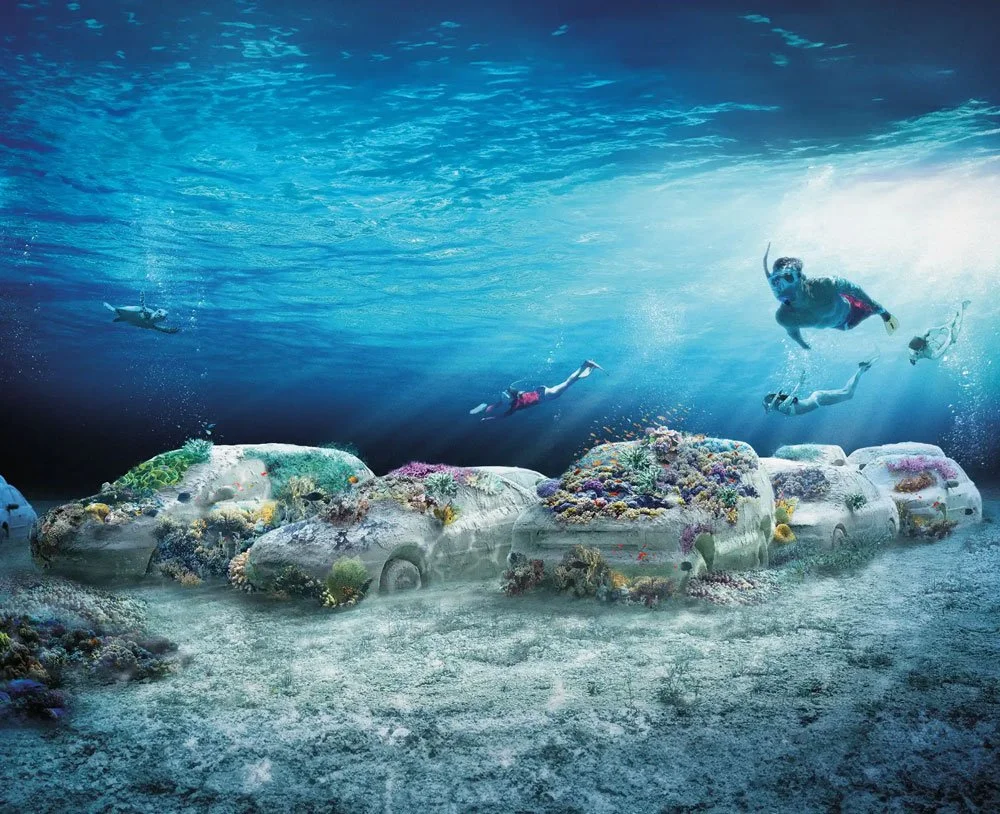
REEFLINE Miami
Infrastructure Carbon Assessment
REEFLINE is an art-led marine resilience project off Miami Beach, combining underwater sculpture, reef restoration and coastal adaptation.
ReefLine needed to understand and communicate the carbon impact of a complex marine infrastructure installation, while demonstrating its wider contribution to biodiversity and coastal resilience without overstating environmental claims.
Technical Approach
The Lever Room developed a forecast, cradle-to-installation carbon model aligned with EN 15978 life-cycle stages A1–A5.
The assessment covered raw materials, supplier-specific emissions data, bespoke mould manufacture, concrete casting, steel reinforcement, road and marine transport, installation energy and waste. Environmental Product Declarations, US EPA emission factors and engineering proxies were integrated into a transparent model, with assumptions and data limitations clearly documented.
Impact
The work gave ReefLine a credible evidence base to demonstrate the project’s intended positive impact while transparently accounting for the emissions associated with delivering it. It identified the main carbon hotspots, clarified where lower-carbon materials, design optimisation, local sourcing and better supplier data could improve performance, and distinguished biodiversity and resilience benefits from carbon-removal claims.
The result was a defensible carbon baseline and a repeatable framework for measuring, communicating and improving marine resilience infrastructure.